This was by far the most interesting chapter of the book thus far. Mass media and broadcasting is ever-present in the world we live in today and I feel many media forms have indeed shaped the way we interpret information.
The beginning of the chapter talks about technologies that have become so prevalent in our everyday lives that if they disappeared people wouldn’t know what to do. For example, the internet has become so widely used and accepted (for most people) that it would be hard to imagine life without it. When I wake up one of the first things I do is check my Blackberry to see what emails I have and maybe look at some news websites. When the internet in my apartment goes down, my roommates and I feel disconnected and uninformed because the web has become our number one source of information. The past 3 summers I’ve gone to music festivals my friends and family will say “how long will you be off the grid for” because when I’m there I turn my Blackberry off and have no internet connection which is a great vacation from the world for those few days.
Mass Media describes forms of media designed to reach large audiences perceived to have shared interests. Mass media to me is T.V. stations like CNN, FOX, MSNBC, etc. These stations give media coverage to “the masses” and inform them with what is going on in the world. Other forms of mass media are newspapers, radio stations, internet, etc. All of these media types get across the same information but in different ways. For example, I rather watch MSNBC or more “left winged” media than Fox News. There has been much controversy that Fox News “spins” certain events that happen in the favor of what political party/person they agree with. Bill O'Reilly comes to mind when thinking of media shows that “spin” news in the favor of their political parties. He clearly is conservative and conservatives usually watch his show. I am pretty liberal so I like watching shows like The Colbert Report because as the book says those shows “are adept at making fun of the conventions of television news in order to show how the news media spin stories and miss stories.”
http://www.youtube.com/watch?v=HIVnwYGU9Qo
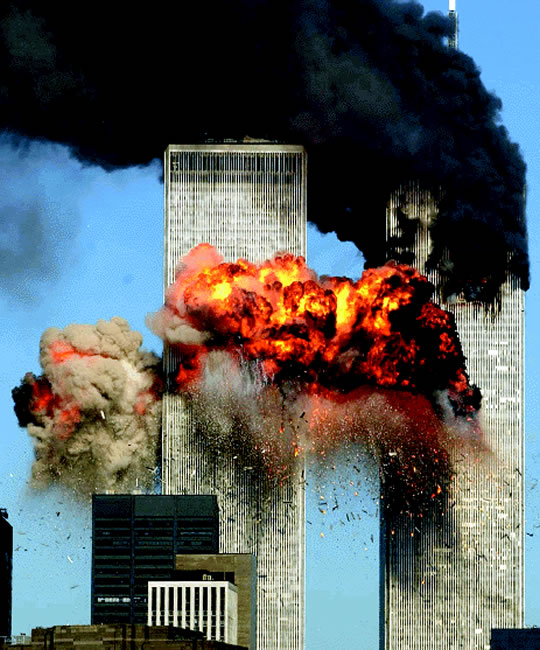
http://www.nocaptionneeded.com/wp-content/uploads/2007/09/wtc-9-11.jpg
The National and Global Media Events section in this chapter was pretty interesting as well. The chapter talked about the 9/11 attacks and how millions of viewers could watch it live from a safe distance and looked at it more of a movie than of actual news. I remember the exact time and place I heard about the twin towers getting hit and where I was when I saw them crumble to the ground. The quote in the chapter by Slavoj ZiZek was pretty moving to me “we can perceive the collapse of the WTC towers as the climatic conclusion of twentieth-century art’s ‘passion for the Real’- the ‘terrorists’ themselves did not do it primarily to provoke real material damage but for the spectacular effect of it.” I always thought that the twin towers blowing up visually communicated many things like defeat, and sent a message that the U.S. isn’t untouchable but ZiZek’s quote really depicts what the terrorists really wanted to do. If you think about it that attack was pretty genius, obviously every form of media would cover what happened and in the end, as the book states, “…but that spectacle is understood to have the potential to generate vast, global shock waves of violence that go beyond the actual destruction of life and property in the single event. These shock waves include invasions, sanctions, ethnic and religious conflict, and wars fanned by media spin.”
Overall, I feel people need to be picky about what “media” they choose to watch and believe. Media networks today are masters at spinning topics and issues to subliminally get a viewer to think a certain way and it’s a sad thing when people who are unaware of these tactics get tricked into maybe believing the wrong thing.
http://www.pbs.org/wgbh/pages/frontline/video/flv/generic.html?s=frol02p74&continuous=1